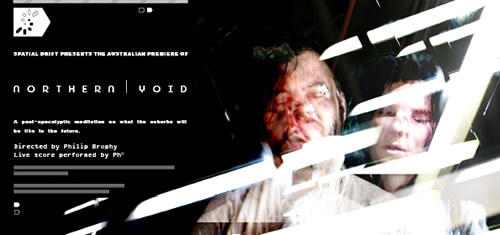
Flyer for Northern Void.
Originally published on Sleepy Brain, 19 February 2007.
Last night I attended the second (and last, for now) screening of Philip Brophy’s 50-minute film Northern Void, billed as a “live cinema performance” accompanied by the real-time sonics of Ph2 (Brophy and Philip Samartzis). Northern Void is set along Plenty Rd, in the northern Melbourne suburb of Preston — specifically a three-kilometre, decaying industrial zone. The film is divided into three sections: The Present, set in 2013; The Future (2085); and The Post-Future (3079).
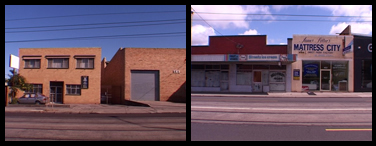
“The Present”: Northern Void (dir. Philip Brophy).
In “The Present”, a series of tableaux unfold: factories, blank business parks, decrepit office buildings, brutalist petrol stations. They look like still shots, but close examination reveals subtle motion: clouds inch along; a bird flaps in the distance. There are no people. The shots are looped; almost imperceptibly, the clouds return to their original position. Is this a deliberate aesthetic? Or a a necessary suturing to prevent the intrusion of offscreen elements irrelevant to the plot? In any case, it’s very effective: nothing happens. Everything remains the same, trapped in an eternal loop. The sound design begins with processed field recordings: birds, insects, magnified to unbearable levels. It settles down and melancholic piano chords pick their way through.
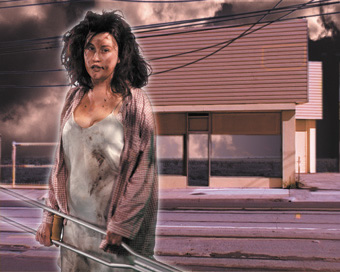
Madeline Hodge in Northern Void (dir. Philip Brophy). Photo by Pancho Calladetti.
In “The Future”, the same shots appear, except this time the factories and buildings are pockmarked and scarred, and everything is infested with a queasy, irradiated digital-pink glow. Glowing red clouds gather overhead, and suburban zombies begin to appear: young people, spectral — they are see-through at the edges — repeating bizarre facial and physical tics.
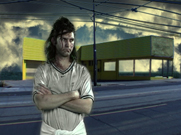
Left: Nat Bates in Northern Void (dir. Philip Brophy).
One poor soul scratches his ear over and over again; another (played by Nat Bates, director of the Liquid Architecture sound-art festival) looks to the ground and back up over and over, mimicking the film loops in the first part of the film. The sound in this section is brilliant, with Samartzis generating extremely unnerving electrical effects — like dying power stations — and violent feedback via what appears to be hyper-magnified recordings of fire. Brophy, meanwhile, triggers some kind of funky synth-bass line, obviously unable to escape his iconic 80s past.
In the “Post-Future”, nothing remains of the buildings, or the zombies, really, except their shapeshifting ghosts, which float around a blasted landscape, totally devoid of life. The sound design amps up a notch. Yep, you guessed it: it’s positively unearthly. Who knows what these guys have done here? Fed cicadas through a cheese grater and processed it in a digital blender, for all I know. It’s freaky stuff. And that colour palette: it’s the colour of rotting pork or severed heads. Or something.

Postcard design for Northern Void (dir. Philip Brophy).
Northern Void is a savage vision and continues Brophy’s aim — started in his feature film, Body Melt — of completely irradiating Australia’s suburban “non-places” and seeing what bizarre life forms sprout in the aftermath. An extrapolation, of course, of what he perceives as a process that’s already in place in a late-capitalist society, specifically Plenty Rd, where, he writes, “cracked 60s brickwork, shrivelled 70s council shrubbery, peeling 80s computer-typeset signage, 90s Day-Glo painted lettering on darkened windows [represent] the corpus of business: dying slowly while tethered to an indifferent life-support system.”
At first glance, Brophy’s vision seems similar to J.G. Ballard’s: the latter is also concerned with laying waste to the suburbs in different and imaginative ways. Both are concerned with a type of posthumanism. But Ballard sees the total breakdown of society as a chance for people to “embrace the catastrophes for their own psychological needs” (quoted in The Sunday Times, 1990) — to reinvent themselves free of the restraints of technological society and its “toxic imagery”.
Brophy’s world is far bleaker. There is no reinvention, no way out. For Brophy, late capitalism is the end of history. Entropy and the serpent’s tail of consumerism wins. It’s too late to do anything about it except go down clicking your fingers to a funky bass line.
Still, I wouldn’t call the film wholly successful. Fifty minutes seems far too long for a plotless conceit such as this, as visually stunning and as sonically challenging as it is. Northern Void outlines an exasperating 22 scenarios that develop over the three stages of the film (although I’m aware there are valid points to be made about repetition and boredom and so on). Half that, or even less, and I don’t reckon I’d be fidgeting in my seat, as I was.
I’d be exhilarated, in fact (although that would be more a Ballardian conceit than a Brophyism).
Note: Northern Void is now moving onto screenings/performances in London and Moscow.

Postcard design for Northern Void (dir. Philip Brophy).