
This is the full version of an interview that was published in various forms in the Age newspaper and RealTime magazine. I interviewed Adam prior to his Oscar win for Harvie Krumpet. Neither of us had any idea of what was to unfold over the next few months, and to see Adam on television in his red cravat accepting his Academy Award was like seeing the guy next door through the wrong end of a telescope. A well-deserved win, naturally, but surreal and dislocating as well.
Small sections of this interview previously appeared in RealTime magazine and The Age newspaper. Thanks to both publications for permission to reproduce them here.
Originally published on Sleepy Brain, 20 June 2003.
Adam Elliot is possibly Australia’s most successful director of short film. His 23-minute claymation, Harvie Krumpet, won three of the four major prizes at the 2003 Annecy festival, the world’s premier animation showcase. That success makes it eligible for Oscar nomination. Harvie also won the Melbourne International Film Festival’s Best Australian Short Award.
Elliot made his first claymation in 1996, Uncle, the first instalment of a trilogy that includes Cousin (1998) andBrother (1999). Harvie Krumpet is the peak of this richly observed body of work, a unified aesthetic that elevates ordinary characters over extraordinary situations.
Elliot stumbled into animation: he badly wanted to be a vet, but ended up studying graphic design. Still restless, he deferred from study and sold handpainted T-shirts down at the St Kilda market for five years. He loved the lifestyle and the cash, but still thought, “Is this what I’m going to do for the rest of my life?” On impulse, he went to the Victorian College of the Art’s Open Day and applied for film school.
While at the VCA, Elliot had the idea for Uncle – his quirky, fascinating character study – and wanted to do it as drawn animation. But his lecturers convinced him to try a different tack.
How did Uncle end up as claymation?
At the VCA, one lecturer in particular, Robert Stephenson, saw something that I didn’t. Also, we had to do a 30-second claymated exercise at the beginning of the year that involved making a TV commercial for snail pellets, and my little grey snail seemed to exude a certain something. I had fairly decent carpentry skills that my father taught me as a child, so I already had a firm grounding to make models and sets. Everyone else seemed to be doing cel animation and there was a lot of 3D equipment at my disposal, so all these factors pushed me into a career with plasticine!
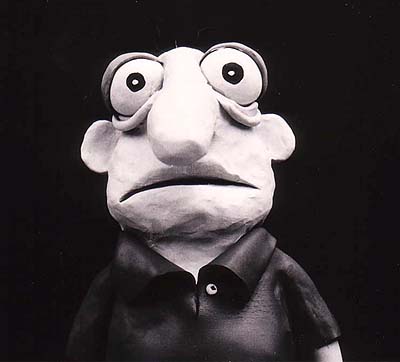
Uncle (1996; dir. Adam Elliot).
Can you see yourself making 2D films now?
No. I’m definitely pigeonholed as a claymator. People also ask me if I want to do live action, but I just enjoy making things I suppose – it’s the “hands on” aspect. I don’t think I could do computer animation. I’d get very frustrated being in front of a computer screen all day. I love to get my hands dirty, and I’ve always loved making things out of pipe cleaners and egg cartons since I was a kid. Computers just frustrate me endlessly.
Elliot is an open, generous interviewee: wistful, philosophical and funny. It’s a cliche, sure, but certainly applicable here: his “enthusiasm is infectious”. He tells me that he was born with a physiological tremor that affects his entire nervous system. Everyone shakes, he says, but he does more than most. The disorder is absorbed into his work: his models are bigger than normal, making it easier for him to move them. Perhaps it also accounts for the distinct look his characters have: all wobbly, misshapen body parts.
Does your condition feed into your animation style?
It’s funny. My films are about people with disorders. And I’ve got a disorder myself. But I’m on some medication at the moment, which is really helping to control it. In Cousin, the Cousin character takes anticonvulsants to help his cerebral palsy and the irony is that’s exactly what they’ve put me on in the last few weeks. People often ask me how much of me is in my films, and at first I say they’re quite fictitious. But perhaps there’s some kind of subconscious thing going on.
Tell me about your influences.
My biggest influence is Michael Leunig. He’s more of a poet than a cartoonist and he has that really lovely balance between humour and pathos – that’s what I try and achieve in my films, because life’s not all fun and it’s not all tragedy. It’s a balance. Barry Humphries is my other big inspiration. I go and see all of his shows when he’s in Melbourne and I always look forward to the Sandy Stone monologues. They’re just so funny, yet so sad and powerful.
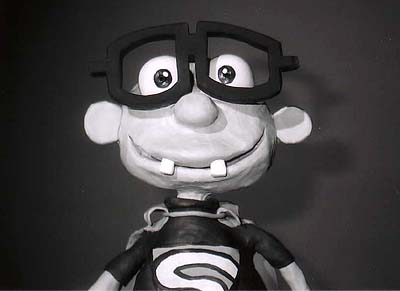
Cousin (1998; dir. Adam Elliot).
Do you get writer’s block?
Some days it just flows, and other days… I have all these rules for myself: I get up at 6 in the morning and I have a very regimented way of writing, because I’m useless after about 3 or 4 in the afternoon. I read a lot, and I get a lot of ideas from biographies. My favourite is Barry Humphries’ second biography.
Elliot’s narratives are observational. Characters might have thalidomide or cerebral palsy; Harvie Krumpet loses a testicle and suffers all manner of misfortune. It’s all about detail: melancholy, piecemeal fragments of memory refracted through the benevolent lens of Elliot’s narrators (William McInnes in the trilogy; Geoffrey Rush in Harvie Krumpet ). Uncle, Cousin and Brother are childhood remembrances of three key family members – cigarette butts, asthma, lemon trees, lice, pet rocks and all. Harvie Krumpet is the story of a Polish immigrant cursed with the worst bad luck. The message is very, very simple: enjoy your life, despite the obstacles. There’s much love in these films.
What attracts you to underdogs?
It’s very hard to put into words. I’m not saying I’ve had a horrible upbringing, but I always seem to relate to people who aren’t winners. I was always the last to be picked on the football team. I think we’ve all been in that position in some time in our lives, where we’ve been the reject.
Do you reckon a lot has changed about your writing and your general aesthetic since you first began?
When I made Uncle and Cousin, I was an intuitive writer. I had a little bit of training at film school, but really I was just writing from my gut. Now I’m starting to do a little bit of navel gazing and analysing why I write this way. My models and sets have become a lot more detailed and sophisticated and my skills as an animator have improved, although animation is one thing I’m not as good at – that is, actually moving the characters. I’ve never done a walk cycle; I’ve never made a character walk. I’m petrified of doing that!
Although in Harvie Krumpet you made wheelchairs move.
Yep, I can do wheelchairs! But in the future I’ll probably let other people animate and I’ll direct and do the character design.
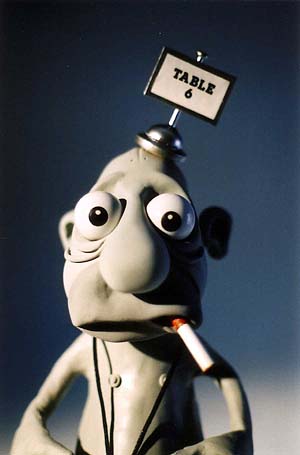
Harvie Krumpet (2003; dir. Adam Elliot).
People have lumped you in with the Aardman school of claymation. Do you feel an affinity with Nick Park?
I admire the technique and I do admire where Nick Park’s coming from. But I think we tell stories in different ways. His films are much more commercial and marketable and merchandisable, whereas I don’t think my little characters who’ve got cerebral palsy can be turned into McHappy meals.
What’s the role of editing in animation? I imagine everything would be thoroughly worked out beforehand, so that an editor wouldn’t have much to do.
Generally when animators give their films to editors there’s not much to edit – they rarely waste a frame. But I’m one of those weirdo animators who like to shoot the scene from two different angles with an extra five to 10 seconds either side. Bill Murphy edited Harvie: he’s from a live action background, he edited Romper Stomper for example, and this is his first animation. He thought he’d be able to edit the film in three days. It took weeks, but he loved the fact he had things to play with: he could swap shots around, and he could extend shots.
The wheels of those wheelchairs were pilfered from shopping-trolleys. The character models themselves are the size of a wine bottle, and their arms are made from plasticine, the head and torso from car bog – the pink stuff panel beaters use – and the sets from wood. Claymation is an absolutely fascinating discipline. Elliot says that when Harvie Krumpet was being made, on a typical day he’d only get three to five seconds footage per day. Some days he’d get one whole minute – if the shot was static, he could just let the camera roll over. It’s certainly an intensive process: Harviecontained 280 shots in 23 minutes, as many, Elliot says, as a lot of feature films (he also tells me that during the shoot he went “stir crazy” and talked to his models).
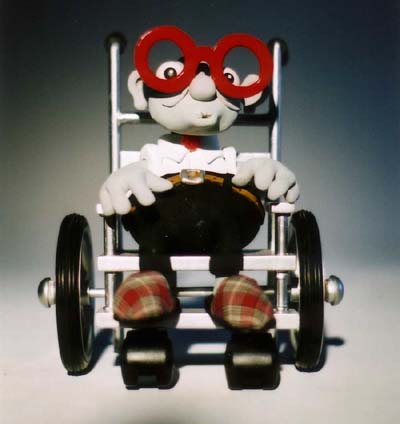
Harvie Krumpetwas in production for a long time.
Yes. It took 14 months to shoot and post-production was another four months. Before that, it took around two years to get the finance to make it. And then it took me three months to write it. I’m a very slow writer and I do a lot of drafts, so I took out a huge bank loan and just locked myself away for three months. I did 17 drafts of a 28-page script.Harvie Krumpettook a lot longer to write than anything else I’d done, because there was so much I wanted to tell about this character. Just with all the facts and trying to get everything accurate: researching Poland and the language and so on.
Harvie Krumpet (2003; dir. Adam Elliot).
It’s interesting that shorts don’t make money. Audiences really want to see them – you only have to look at the popularity of short-film festivals – but the marketing people just don’t seem to know how to handle them.
I had a meeting with the VCA the other day and they had some Federal MPs there from Canberra. These MPs wondered why shorts aren’t shown before feature films. I said, “Well, why don’t you pass a law that there has to be shorts before features?” And they said, “That can quite easily be done”. But at the end of the day you’re up against Coca Cola and other advertisers: a Coca Cola ad makes more money. It’s such a shame because every feature director has cut their teeth making a short.
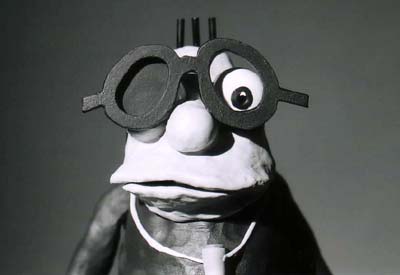
Brother (1999; dir. Adam Elliot).
Has knocking them dead at Annecy led to further opportunities?
At Annecy, a major distributor snapped up Harvie Krumpet , after two or three were in the running. But winning mainly means we get into more film festivals: we’ll now be invited to screen as opposed to having to submit (and we’ll save a fortune in courier costs). When I first started making shorts, I thought that winning a prize meant that someone would give me a cheque to fund my next film. But it never happens like that. Even if we get nominated for an Oscar, it doesn’t really make life easier. It opens doors a little but you still have to push your way through.
You speak highly of your producer, Melanie Coombs. What’s the value of a good producer?
Melanie is everything I’m not. She’s very good at putting budgets together and predicting how much a film will cost. She supports me on every level of the process. So often a director gets all the attention, but what I do is a real partnership with Melanie. She’s been with me right from the beginning of Harvie Krumpet, although she approached me back when Cousin came out. She said if I wanted to do a longer format, she’d be really interested in producing – not for any commercial reason, but purely because she’s in love with the art form.
Given the time frames involved, I wondered if Elliot had it in to him to make a feature-length claymation. The answer is “yes”: he once reckoned half an hour was impossible but now he’s achieved that, a feature is looking do-able, although there are huge costs involved (Elliot estimates that it would cost anywhere between 10 and 80 million dollars to make). For the moment he’s happy to do shorts, reasoning that if they can move an audience then he’s happy.
Harvie Krumpet’s fully realised soundtrack is a notable departure from your trilogy, which had no music, just ambient sounds and narration. How did that aesthetic change?
Early on, I really wanted to concentrate on the animation. I wanted to convince myself – and the audience – that you can drive a film with just narration and imagery. My characters rarely speak, so really I was experimenting. But there’s two or three classical music pieces that I just love and when it came to Harvie, I thought I’d see if I can do an amalgamation of music, narration and imagery – with a little bit of lip sync. There’s one song in there, “God is Better than Football, God is Better than Beer”, which is an old Sunday-school song. A friend of mine used to sing it, and he didn’t know all the words to it; it took us months to actually find out who wrote the song and how to get the rights to it. It’s by this guy, Keith Binns – he writes songs about God.
Is it fair to say there’s an old-world aesthetic running through your films?
Yeah. I use a very old Bolex camera and I like to think I’m making films the same way they did fifty years ago. The technique is exactly the same. We do use a video-assist camera linked to a laptop, just to see what we’re doing. But it’s still done the traditional way, and audiences like that. The proof’s in Chicken Run and the new Wallace & Gromit feature that’s coming out in a couple of years. Audiences like to see fingerprints on the plasticine – it proves that what they’re seeing is tangible.
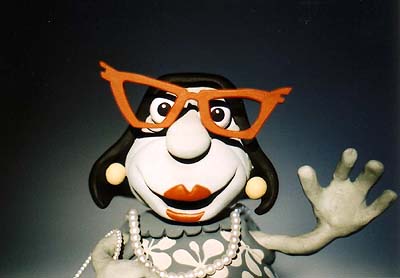
Harvie Krumpet (2003; dir. Adam Elliot).
How did Geoffrey Rush and Kamahl come on board for Harvie Krumpet?
I’d used William McInnes as narrator for my first three films, but withHarvie I thought I should try and use different actors. Melanie wondered who would be my dream narrator. At the time I was thinking of Ruth Cracknell, but she died, unfortunately. But I really loved Shine, and I’d seen Geoffrey Rush in other films: he has that universal timbre to his voice, not too English and not too American or Australian. There seems to be an honesty and integrity to his voice. So it was quite simple: we approached him, showed him the trilogy and he loved it. He read the script for Harvie Krumpet and took to it immediately. And Kamahl was easy: we just rang him up and said Geoffrey Rush was involved, and he said, “I’ll do it”.
Aside from the soundtrack, all your films seem to have a unified style. How do you see Harvie Krumpet in relation to the trilogy?
Looking at it now, I reckon Harvie is too colourful. I think the next film I make will be a return to monotone or sepia. Harvie is a lot more detailed than I anticipated. I really like the crudeness of Uncle, Cousinand Brother, but since it was a commercial half hour for TV, I felt thatHarvie had to be more dynamic and colourful. I think I went a little bit overboard, but that’s just me. Most people would disagree.
It’s a busy time for Elliot. He’s just been to LA to push forHarvie Krumpet ‘s nomination for an Oscar, and he’s writing a claymation series, Urban Eccentrics, for SBS. As he’s a “very slow” writer, he probably won’t finish this for a good while yet. He’s also just finished a kids’ book, The A to Z of Monsters (which took him eight years to write) but he’s not sure what to do with it. It might turn up as an animated series first and then a book.
Isn’t your style a little dark for kids?
I keep forgetting how sophisticated kids are these days. The other night I saw Pirates of the Caribbean and this little girl next to me said she only shut her eyes once. And I thought that film was very scary!
LINKS
Harvie Krumpet
Melanie Coombs interview
ADAM ELLIOT FILMOGRAPHY
Uncle (1996; 6min): “The biography of a humble man, his lemon tree, chihuahua and crumpets”.
Cousin (1998; 4min): “The childhood remembrance of a cousin, his special arm, pet rocks and shopping trolley”.
Brother (1999; 8min): “The childhood memory of a brother, his cigarette butts, asthma and head lice”.
Harvie Krumpet(2003; 23min): “The biography of an ordinary man seemingly cursed with bad luck. From being born with Tourette’s Syndrome to getting struck by lightning, from having his testicle removed to developing Alzheimer’s disease – Harvie’s troubles seem neverending! Yet, Harvie learns many lessons about life and enjoys its many fruits. He finds love, freedom, nudity and, ultimately, the true meaning of what it is to be human”.
For more information, contact Melanie Coombs at Melodrama Pictures:
PO Box 347, Fitzroy, VIC 3065, Australia
(t) +613 9416 3566; (f) +613 9417 7336;
(e) melodramapictures@bigpond.com